Language development activities for toddlers are especially crucial during ages 1–3, which are considered the golden years for language growth. During this stage, a child’s brain absorbs vocabulary, tone, and sentence structures best—like a sponge constantly soaking up new knowledge. But it’s not just about “absorption.” Young children also need stimulation through real, interactive activities with parents or caregivers to learn effectively.
Here are 7 ways to promote language development with simple daily activities that moms can do to help their child speak early, speak well, and say more than you’d expect!
Language Development Activities for Toddlers: 7 Easy Ways to Help Your Child Talk More and Sooner
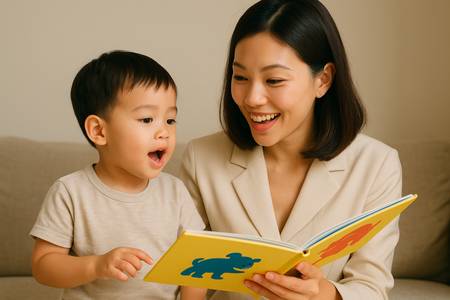
1. Read stories to your child every day: Expand their vocabulary through their favorite books
Reading stories isn’t just fun—it’s the best foundation for language! Research from the American Academy of Pediatrics (AAP, 2014) shows that children who are regularly read to have up to 1 million more words in their vocabulary than their peers by the time they enter first grade.
Example language development activities for toddlers:
- Choose picture books with repeated words
- Point to pictures while reading and ask, “What is this, sweetie?”
- Use varied tones and try voicing the characters—this will grab your child’s attention
- Repeating the same book often helps children remember words and stories well
Reading one book a day, taking no more than 10 minutes, is a language development activity that can truly help your child become a confident speaker.
2. Sing songs and play with rhymes — have fun while learning
Songs are an incredible tool for language development! The rhythm, pitch, and repetition in songs significantly boost a child’s memory and language comprehension. A report from NAEYC states that children who listen to songs or rhymes daily show better language development than other groups.
Example language development activities:
- Sing songs like “Little Ant” or “Elephant, Elephant”
- Clap hands to the rhythm to improve focus
- Practice rhymes like “Meow meow kitty, rolling and twitty”
- Use a toy microphone and let your child play singer!
Even if you sing off-key, it’s okay. What matters is that you sing with intention—your child will remember it all!
3. Talk to your child regularly, even if they can’t talk yet
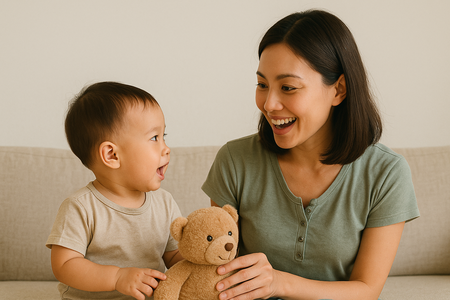
It’s okay if your child can’t talk yet—they’re still listening! Research from the Harvard Center on the Developing Child suggests the “Serve and Return” method: two-way interactions. For example, when your child looks at you, say, “Hi sweetie, are you hungry?” Then pause and wait for them to respond (even if it’s just an “uhh” sound).
Example language development activities:
- Narrate everything you’re doing, like “Mommy’s frying eggs. It smells so good!”
- During bath time, ask, “Is this water?”, “So many bubbles!”
- While playing, describe things: “This doll’s name is Bear. He’s gray.”
- Pause to let your child respond—even if it’s in baby talk, it still counts as speaking!
The more you talk, the more your child connects words in their brain, building a strong foundation for communication.
4. Limit screen time, focus on real human interaction
Many families use YouTube as a babysitter… but this can unknowingly lead to delayed speech. A study from JAMA Pediatrics (2019) found that children under 2 who spend more than 1 hour a day on screens are twice as likely to experience delayed speech compared to the control group.
Example language development activities instead of screen time:
- Play with wooden blocks and name the colors: “This is red, this is green”
- Guess animal sounds: “Woof woof — which animal is that?”
- Match picture cards: “Dog and bone,” “Cat and milk”
- Go for a walk and point to birds and leaves while saying the words aloud
Quality time with your child builds their language skills far more effectively than screen time.
5. Let your child play with other kids: learn through peers
Children learn faster through imitation! A study from the Child Development journal (2013) found that kids who often play with peers of the same age show better language development than those who play alone.
Example language development activities:
- Organize a casual playgroup at home
- Play pretend games like “grocery store” or “restaurant”
- Color together and ask, “What picture is this?”
- Take your child to a playground and observe their interactions
Even short phrases like “No!” or “Mine!” are valid forms of language practice.
6. Speak slowly, clearly, and use simple words
Did you know that speaking to your child slowly, clearly, and with repetition—called “Parentese”—has scientifically proven effects on language development? A study from the University of Washington (2018) showed that children regularly exposed to Parentese have stronger brain connections in language areas than those in the control group.
Example language development activities:
- Pick up a toy and say, “This is a dog, dog, dog. These are the dog’s ears.”
- While tidying up toys, say, “Let’s clean, clean, clean up the toys.”
- Instead of saying “Go eat!” try “Let’s go eat, are you hungry, sweetie?”
Repetition and clear speech are like brain fertilizer for your child.

7. Give your child a chance to respond—even if they can’t speak yet
A child’s brain needs “thinking time.” Research from MIT shows that pausing after asking a question (wait time) helps children process information and practice responding, even if they can’t speak real words yet.
Example language development activities:
- Ask, “Did you have fun today?” then wait patiently
- Hold up two toys and ask, “Do you want to play with the bear or the duck?”
- While reading a story, point to a picture and ask, “What’s this?”
- Even if your child responds with “Uh uh,” reply with, “Oh, you want to play with the bear? That’s great!”
Trust that every “sound” your child makes is a form of communication waiting for your response.
Your child’s speech is the result of your care and attention
Promoting language development doesn’t require expensive toys or advanced technology—just “time, love, and meaningful conversation.” Through simple daily language development activities, your child can become a confident and early speaker.
And if you start to feel concerned that your child is speaking less than expected—such as saying fewer than 10 words by 18 months—please consult a developmental pediatrician right away.
Originally published on theAsianparent Thailand
American Academy of Pediatrics. (2014). Literacy Promotion
Harvard Center on the Developing Child. Serve and Return
JAMA Pediatrics. (2019). Screen Time and Child Development
NAEYC. Music and Early Learning
Child Development Journal (2013)
WHO Guidelines for Children Under 5 (2019)
University of Washington (2018). Parentese and Language Growth
MIT Language Learning Study (2016)


 Money Tips
 Building a BakuNation
 Becoming a Parent
 Ages & Stages
 Parenting
 Health & Wellness
 Education
 Lifestyle Section
 Become a VIP
 TAP Recommends
 Shopping
 Community
 Rewards
