A mother can’t help but worry: “If one day I’m not around, will my child have what they need?” Because no parent can run to help their child every single time a problem arises. That’s why teaching kids problem-solving skills is essential—teaching kids problem-solving skills helps raise children who can think for themselves, make decisions confidently, and get back up to fight on without depending on us forever.
What is problem-solving skill?
Problem-solving skill is the ability to recognize when a problem arises, evaluate possible options, predict outcomes, choose the most appropriate course of action, and assess the results after taking action.
In child psychology, this skill falls under the same category as Executive Function (EF), which also includes the ability to regulate emotions, think flexibly, and plan ahead.
Dr. Adele Diamond, one of the world’s leading experts on EF, explains that children with strong EF have a high ability to solve problems independently, can focus well, and are able to handle disappointment effectively.
Most importantly—this skill can be trained from a young age.

Statistics and research confirm that children who can think for themselves recover 4 times faster
Research from the Harvard Center on the Developing Child found that children with problem-solving skills are up to four times more likely to recover quickly from stress, because they “know where to start and don’t panic when faced with a dead end.”
In contrast, children who have never practiced problem-solving tend to avoid problems or constantly seek help.
Training this skill from the preschool years is therefore a crucial foundation for good mental health in the future.
Examples: When a child lacks problem-solving skills
Case 1: Jay, age 5, cries every time his building blocks don’t fit together. His mother always rushes to help because she’s afraid he will get stressed. Jay begins avoiding more challenging toys for fear of “making another mistake.”
Case 2: Mook, a kindergarten student, is afraid to enter her new classroom because she worries, “What if I need to pee and can’t find the bathroom?” Her mother tries to comfort her but doesn’t teach her how to think through the situation. As a result, the child chooses “not to go to school at all” to avoid the problem.
What these two children lack is not courage or intelligence—it’s the foundation of analyzing problems, thinking of alternatives, and making decisions independently.
Problem-solving skills can begin even before a child can speak clearly
Many people think, “We can train them when they’re older.”
In reality, this skill can be developed as early as age 1–2 through simple daily activities—like picking up something that has fallen under the table, assembling toys, choosing clothes, or finding lost items.
Young children naturally engage in “trial and error,” but when parents “always step in to help,” the skill never develops.
Practical techniques
-
Don’t step in right away. Wait, then encourage thinking: “Can you try another way?” or “Where do you think we should start?”
-
Be a coach, not a hero. You don’t always have to be the rescuer—be the one who stays by their side while they try, fail, and try again.
-
Reflect after solving the problem: “Did the method you chose work?” or “If it happens again, would you do the same thing?”

Practicing Problem-Solving Skills Through Play
The American Academy of Pediatrics (AAP) states that children learn best through free play because play is a miniature version of life—where children can face challenges, choose methods, and learn outcomes in a safe environment.
Recommended games and activities:
- Picture puzzles
- Scenario-based games, e.g., “If you lose your shoes at school, what would you do?”
- Role-playing, such as playing doctor and patient, or customer and shopkeeper
- Strategic board games, e.g., 10 planning board games to sharpen your child’s mind for ages 4+
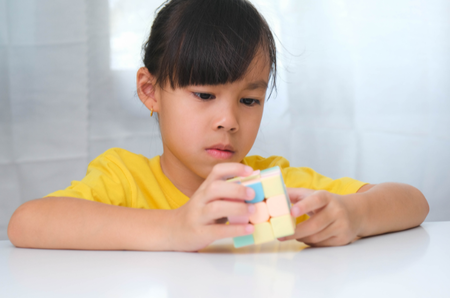
Teach Your Child to Fall and Rise Again
A child who never falls has never learned that failure can be a “teacher.”
Problem-solving skills don’t come from constant success — they grow from the effort to stand back up, over and over again.
Parents need to shift perspective from…
- “I’m afraid my child will make mistakes” → “It’s good that my child gets to learn”
- “I’ll help before it goes wrong” → “Let my child think of a solution first”
- “I have to fix it right away” → “I’ll be here if my child wants to try again”
Problem-Solving Skills: A Life Asset More Valuable than Grades
In a world where the future changes faster than ever, academic excellence alone doesn’t guarantee survival in real life.
But a child who dares to face challenges, think of solutions, and rise again is a child prepared for the real world.
Because when we teach our children to “think for themselves,”
they will “trust themselves,”
they will “not panic in the face of failure,”
they will “see problems as opportunities to learn.”
On the day parents can’t always be there to help, we must trust that our children carry a secret weapon — not a phone, not grades, not talent, but the ability to think and solve problems independently.
Let them fall sometimes. Let them take their time. Let them make mistakes.
Because every step they think through on their own is a step toward true growth.
Originally published on theAsianparent Thailand


 Money Tips
 Building a BakuNation
 Becoming a Parent
 Ages & Stages
 Parenting
 Health & Wellness
 Education
 Lifestyle Section
 Become a VIP
 Press Room
 TAP Recommends
 Shopping
 Rewards
