When your little one bends down to pick up a tiny stone or a piece of leaf while walking, parents may sometimes slip and ask, ‘Why are you picking that up? It has no value at all.’ But this simple act reflects why kids love collecting things—for the child, it is a treasure chosen with pride. A child’s love for collecting things isn’t hoarding or abnormal behavior—it’s an important step in learning how to manage their own little world, and it marks the beginning of life skills that will stay with them in the future.
Why Do Children Love Collecting Things?
Young children cannot yet fully grasp the complexity of the world. Picking something up and claiming it as “mine” is part of building a crucial sense of ownership. Psychological research by Jean Piaget points out that children begin to learn about the concept of “mine” and “yours” during the ages of about 2–7 years (the preoperational stage). Understanding why kids love collecting things shows us that this is a natural behavior that helps them practice boundaries and develop independence.
From the child’s perspective, the little things they choose to keep are full of meaning—whether it’s a rock from the playground, a leaf found on a rainy day, or a brightly colored bottle cap. These objects explain why kids love collecting things, because they make children feel they can “control” and “choose” something important in a world far too big to fully understand.
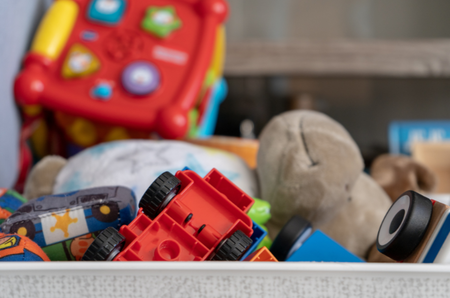
The Psychology of Collecting: A Small World Full of Learning
A collection is more than just a group of ordinary objects—it is a “mini laboratory” for children to train both their mind and heart.
- Building a Sense of Order: Children often sort or arrange things—for example, separating small and large stones, or organizing leaves by color. This is a way of practicing logical thinking and information management.
- Learning Ownership: When a child says “This is mine,” it marks the beginning of understanding boundaries, which later develops into the ability to genuinely share with others.
- Connecting with Emotions and Memories: Some objects are not just items but represent moments or feelings—for example, a small doll given by their mother when they were sick.
The Harvard Graduate School of Education explains that collecting strengthens “agency”—the sense of having control over certain aspects of one’s life—which is essential for building a child’s confidence and identity.

The Benefits of a Child’s Love for Collecting
This behavior hides many layers of learning that parents may not immediately see:
- Practicing Prioritization: Children must decide whether to keep or not keep something, which trains decision-making and selective thinking.
- Building Responsibility: When they intentionally collect, children learn to take care of their treasures so they won’t get lost or damaged.
- Developing Management Skills: Sorting and categorizing items also support other skills, such as planning and problem-solving.
- Stimulating Creativity: Ordinary objects can become characters in imaginative play—for example, a leaf becomes money, or a stone becomes food.
- Creating Emotional Value: Some items serve as a “memory journal” that children grow attached to, such as objects collected on a special day.
How Parents Can Support Their Child
A child’s love for collecting should not be dismissed as meaningless. On the contrary, with the right support, parents can help turn this behavior into a valuable learning opportunity.
- Give them a small personal space: It could be a little box or drawer where they can keep their collection. This teaches them to have a sense of “my own space.”
- Respect the meaning your child gives to objects: Instead of quickly dismissing something as worthless, show interest by asking, “Why did you keep this stone?” This opens the door to meaningful conversations.
- Guide them on cleanliness and safety: Help them distinguish between what is worth keeping and what may be unsafe, such as trash or sharp objects.
- Use it as a lesson in organization: Encourage your child to sort their items—for example, by color or size. This builds organizational skills.
- Create opportunities for sharing: Teach that some items can be given to friends or used to tell stories. For example: “Do you want to share this stone with your friend so you can both have a matching collection?”
When Should Parents Be Concerned?
Although collecting is a natural behavior, there are certain patterns that may require closer attention:
- Collecting beyond control: If a child refuses to throw anything away and the home becomes cluttered, interfering with daily life.
- Excessive attachment leading to aggression: If the child reacts strongly when anyone touches their collection, even slightly.
- Lack of balance in daily life: If obsession with collecting overshadows play or other forms of learning.
- Collecting unsafe items: Such as broken glass, dirty objects, or anything that could cause harm.
If these behaviors start to interfere with the child’s everyday life, parents should consider consulting a child psychologist or developmental specialist for guidance. Seeking professional advice doesn’t necessarily mean something is wrong with the child—it simply helps parents find better ways to offer support.
A child’s passion for collecting is normal and offers tremendous benefits for both the mind and the heart. It is how children learn to manage their own small world, practice responsibility, and build emotional value. With understanding and support, parents can help transform their child’s little treasures into the foundation of life skills and confidence—preparing them to grow steadily in a world that gets bigger every day.
Originally published on theAsianparent Thailand


 Money Tips
 Building a BakuNation
 Becoming a Parent
 Ages & Stages
 Parenting
 Health & Wellness
 Education
 Lifestyle Section
 Become a VIP
 Press Room
 TAP Recommends
 Shopping
 Community
 Rewards
